Learn about the GrabCAD Platform
Get to know GrabCAD as an open software platform for Additive Manufacturing
Visit our new homepage
Home
Control
Shop
Streamline Pro
Partner Program
Print
Community
Log in
Library
Challenges
Groups
Questions
Tutorials
Engineers
Blog
Log in
Learn from thousands of free Tutorials.
New user?
Join the community
or
log in.
Tutorials
Most liked all time
Recent
Most liked
Most viewed
Most commented
This week
This month
All time
Category
Design & CAD
Modeling
Drafting
Assemblies
BOM
Dimensioning / Tolerancing
Translations
Manufacturing & CAM
3D Printing
Tooling
NC Machining
Composites
Measurement / Inspection
Simulation & CAE
FEM
CFD
Kinematics
Process Simulation
Engineering Fundamentals
Theory
Process
Standards
Other
Software
Snagit
Alibre Design
ArchiCAD
AutoCAD
AutoCAD Electrical
Autodesk 3ds Max
Autodesk Alias
Autodesk Inventor
Autodesk Maya
Autodesk Revit
Autodesk 123D
BricsCAD
Bentley MicroStation
BlenderCAD
BobCAD-CAM
CATIA
Delmia
DraftSight
FreeCAD
Femap
Fusion 360
Geomagic Design
IronCAD
JT
Kompas-3D
KeyCreator
KeyShot
Lagoa
Luxology
Mastercam
Moi3D
NX Unigraphics
OBJ
Onshape
OpenSCAD
Parasolid
Powermill
Powershape
Pro/Engineer Wildfire
PTC Creo Parametric
PTC Creo Elements
Rhino
SpaceClaim
SOLIDWORKS
solidThinking Evolve
Solid Edge
SolidFace
STEP / IGES
SketchUp
STL
TopSolid
TinkerCAD
T-Flex CAD
TurboCAD
VectorWorks
ViaCAD 3D
VRML / WRL
ZW3D
GrabCAD Print
Rendering
GrabCAD Community
GrabCAD Workbench
Text file
3D Manufacturing Format
Cinema 4D
Other
Skill level
All levels
Beginner
Intermediate
Expert
blasting
×
Finishing Options for FDM and PolyJet 3D Printed Parts
Stratasys
in
3D Printing
22
1
Beginner
Finishing or secondary operations encompasses a broad range of processes that change a manufactured part’s properties. Engineers can employ finishing simply to improve part’s appearance and reshape it to meet certain dimensions, or use it to enhance functionality, such as increasing strength, chemical resistance, electrical conductivity and more. Secondary operations basically turn raw parts into finished goods and this isn’t limited to traditional manufactured parts. 3D printed parts can also be enhanced with secondary operations, but much like designing for additive manufacturing, different processes and best practices apply. Throughout the product design and manufacturing process, engineers should also be thinking about how 3D printed parts can be finished. Determining the appropriate finishing operations depends on the additive process, material and geometry as well as the desired aesthetics and functionality. This guide explains the primary finishing operations additive manufacturing service providers implement for FDM and PolyJet 3D printing technologies, grouped by possible finishing objectives, and compatible materials and applicable design considerations.
blasting
sanding
smoothing
stratasys
3dprinting
polyjet
finishing
fdm
How to Media Blast FDM Parts
GrabCAD Tutorials
in
3D Printing
1
0
Intermediate
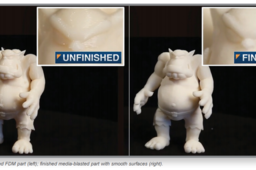
The normal surface finish of FDM parts is suitable for most purposes, but in applications where a different finish is required, media blasting is an inexpensive and quick solution. Following the best practices helps reduce the risk of damaging or breaking a part when media blasting. The following is brought to you by Stratasys.
finish
surface
post-processing
3dprinting
blasting
media
fdm
How to media blast FDM parts
GrabCAD Tutorials
in
Design & CAD
0
0
Intermediate
Common applications where media blasting is applicable: • Smoothing and polishing for: - Concept models - Prototypes - End-use parts • Surface preparation such as texturing and etching for: - Painting - Electroplating - Mold masters
Other
finishing
post-processing
fdm
media
blasting
printing
blast
3d